Web Toolbar by Wibiya morfoLL: February 2009

26 February 2009

Ningbo Historic Museum / Wang Shu, Amateur Architecture Studio


Iwan Baan shared with us one of the latest works he photographed, Ningbo Historic Museum designed by Wang Shu, Amateur Architecture Studio. One memorable project by Amateur Architecture Studio, where the team explored, textures, properties and colors of a vernacular element/material...stone.

Don't miss it in: Arch Daily

.


The Continuous Enclave: Strategies in Bypass Urbanism

For his final student project presented last month at Rice University, Viktor Ramos produced The Continuous Enclave: Strategies in Bypass Urbanism.

[Image: From The Continuous Enclave: Strategies in Bypass Urbanism by Viktor Ramos; view larger].

The project explores how new forms of habitable infrastructure might be extrapolated from a geopolitical agreement – in this case, materializing architectural form from the legal interstices of the Oslo Accords.
The result is a fantastic example of architectural speculation: genuinely massive – and impossibly cantilevered – bridges used as transport links, aerial housing, and skyborne agricultural complexes, all in one.

[Image: From The Continuous Enclave: Strategies in Bypass Urbanism by Viktor Ramos].
via BLDGBLOG


SPARC


HiDrone - 1st Prize Awarded London Architecture Gallery International Competition 2008

SPARC is a team of international architects at the MIT based in Boston, MA, with a multidisciplinary background at the MIT´s Media Lab. This has resulted on a continuous research on smart/responsive environments applied to the world of architecture, design, urbanism and landscape architecture.

This new relation between technologies and built spaces has opened a wide array of possibilities, that we are just starting to see. And that´s why I choose this practice for this week´s AD Futures.

Profile

SPARC, a team of architects at MIT, is a Boston based research practice dedicated to exploring the world of architecture, design, urbanism and landscape architecture through investigations of design techniques and material technologies with regard to their affect on global culture. We explore the relationships between the body and space through performative designs. SPARC's commitment to design innovation has its foundation in the accumulative experience of its founders:

Sergio Araya, Architect, MIT
Orkan Telhan, Media Artist, MIT
Duks Koschitz, Architect, MIT
Alexandros Tsamis Architect, MIT

We work on projects at different scales ranging from object design to landscapes. We often collaborate with artists, designers and innovative consultants in the development of inventive solutions for multifaceted projects.

Research

SPARC's research investigates methods to design and fabricate architecture with different levels of "embedded behavior" or responsiveness by combining different physical material properties of new designed "smarter" composites. This investigation is part of the fundamental interest of SPARC in exploring the relations between body and space through performative design, where designed material becomes an active interface between people and the built environment.

The process for distributing material properties is applied to explore the possibilities of embedding smart behaviors for built components. Aesthetics and function are implicated by this reorganization. SPARC contributes to the professional discourse and the industry, by providing a repertoire of design and building techniques.

HiDrone


1st Prize Awarded London Architecture Gallery International Competition 2008

HiDrone is an adaptable architecture gallery made of hydraulically operating pistons that are virtually and literally reconfigurable, filling and releasing water recycled from the Thames River. HiDrone has two states. When closed, it acts as a 3D screen. When open, it creates occupiable space. The piston operates distinctly at various scales ranging from display unit and furniture, all the way to enclosed, occupiable space. These pistons are pre-stressed with springs, which, when filled with water, assume a closed position. By controlling the amount of water released from the units, the volume of the object acquires different configurations.

In a closed state, the fiber optic light emitters act as voxels programmed to produce visual effects and 3D images for the city of London. In an open state, the pistons form floors, ceilings, and furniture depending on their configuration, creating variable spaces: a cafe, gallery, amphitheater, etc. Depending on the programmatic and climatic needs, the HiDrone is reconfigurable and reprogrammable throughout the course of the year, generating ephemeral public activity as it docks along the river's edge.

Cutting Edge

1st Prize Awarded Gillette Landmark International Design Competition, 2009

Cutting edge is a sculpture made of 51 stainless steel "blades" stacked on top of each other. Cutting edge suggests an interplay between the materiality of the hard edges and the perception of soft volumes arrested in the metal structure.

Soft shapes emerge as a result of the moire effect created by repetition, and change their appearance when viewed from different vantage points. The repetitive use of "blades" is similar to the way Gillette has used the idea of repetition as a main part of its brand identity.

The proposed structure is made of laser-cut, polished stainless steel plates. Each plate is bent to its shape, polished and stacked in place using spacers made of cylindrical bolt assemblies. The cutting patterns will be generated by flattening the 3d geometry and will be provided by us to the executive party.


via Arch Daily

SkyTREE


An excelent project for a skyscraper structure. Towers with the function of populate and reforest degraded areas around the city of benidorm.

to see in UrbanArbolismo


22 February 2009

Skew House

skew house Designer: october ueda+nakagawa architects
Location: Toride-city, Ibaraki, Japan
Image Credits: Hirai Hiroyuki
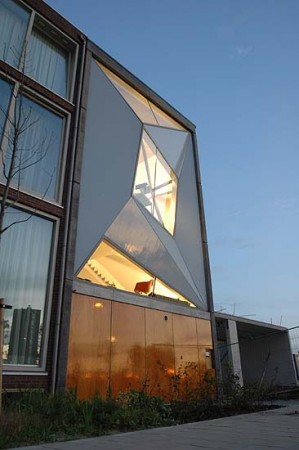
If what one wants to see there is only bamboo and sky, we should realize relatively large windows; large window frames are made by expensive steel so that we designed the steel frames in larger size than needed for glasses for supporting wood panels of walls, floors and roofs. The form of the steel frames has triangle shape for Y-direction structural strength. The X-direction is structured by wood panels on the other. The possibility of linear repetition is good for narrow and long form of the upper horizontal space of the site. october-web.com

via SpaceInvading

Armani Store-M.Fuksas architects

Armani store by Massimiliano Fuksas.

NRJA


what is NRJA? from nrja on Vimeo.

A very interesting video of a very interesting arch studio.

20 February 2009

Blue Frog

A wonderful interior by SERIE architects, an almost landscaped lounge that attracts the view.

Based on this desire to have it all, the question for us is: how do you collapse a theatre, restaurant, bar and club into a warehouse whilst maintaining all the performative characteristics of each individual type?

AEDS-J_house


AEDS architects

July 2006

New Orleans, USA

Residential

In progress - completion 2009

Buro Happold NY, Nathaniel Stanton, Erik Verboon

The J-House uses a historically standard New Orleans housing lot: 30x150 feet. The original site for the J-House is located in a designated flood zone as is common with many housing sites throughout the Southern Louisiana region. Recent FEMA studies have concluded that a vast range of New Orleans housing sites are currently 9-feet under sea level. The original site for the J-House is no different.

Avoiding current political and sociological debates inherent with building houses to ‘new’codes adopted after the historic storms of Katrina and Rita, as well as within areas clearly destined to be under water, the J-House was approached as an opportunity to study the possibilities, as opposed to restrictions, for building high above ground in a restricted lot size. As a housing lot located in a flood zone, the design was bound by elevation requirements; the resulting design is 10’ off of the ground.

The basic design is two 10x20x80 feet tubes. Each tube is rotated 90 degrees from one end to the other. The resulting combination of the two tubes allows for structural support with a minimum foot print for the foundations. The twisting and combination of tubes generates a space under the house that allows for views thru the site. On the roof level the twisting generates a diagonal skylight.

While this house was a type of study of place, constraints and possibilities, the housing surrounds in which it lies were not ignored. The J-House was inspired by the shot-gun house typology; a housing stock that typifies a New Orleans home.

The proposed house is made out of steel structure that is prefabricated and assembled on site. The exterior skin is made out carbon-fiber panels. Carbon-fiber, not only strong and hurricane resistant, is also extremely adaptable to a variety of extreme weather conditions.

17 February 2009

Luxury Hospitality

image

Adding luxury hospitality to the birdwatching experience.

In receiving both the Grand Prize and an Honorable Mention, Morris Architects is the first firm to have been nominated for two of the four finalist positions in a single year. Said Michelle Finn, vice president of Hospitality Design Group, publisher of Hospitality Design magazine, “Innovation deserves a platform. This award offers a glimpse of what is truly cutting-edge thinking.”


via Bustler

16 February 2009

S'A arquitectos


Here you can see the graphic folio of some interesting (friends) architects. Works that relate a different aproach to problems always with sustainability in mind.

http://www.sa-arquitectos.com

S’A arquitectos is a young team coordinated by Carlos Sant'Ana and Isabella Rusconi, with profissional and academic experience in Lisbon, São Paulo and Barcelona. Our goal is to work with strategies that generate systems that propose new ways to complete the urban and natural landscape, trying to consolidate one hybrid system of occupation. Our research field includes themes as flexibility, mobility, energy and ecology.

Labels:

Animated Atmosphere by Nora Graw

squanimated-atmosphere-by-nora-graw_nacht.jpg

animated-atmosphere-by-nora-graw_uebersi.jpg

The building contains cinemas and exhibition spaces for public events alongside offices designed for small businesses involved in the film industry.

animated-atmosphere-by-nora-graw-animated-atmosphere_model2.jpg

The information below is from Graw:

Conventional films are restricted in physical conditions of the film set, or collage an artificial surrounding to suggest the wanted atmosphere and aesthetic. Animated films create an abstract world that mimics qualities of the physical that are extracted and exaggerated in animated films, where characteristics are adopted to create an environment that through its aesthetic creates an all-around coulisse. The goal is to create an environment for this profession with characteristics of the coulisse, layering of scenes and interconnecting various stage settings to take part in the 'real world'.

animated-atmosphere-by-nora-graw_modelj.jpg

My goal was to create surfaces with imprinted conditions (structure, ornament, shading,…) that transform continuously through blending and superimposing specific surface information to create a diverse set of scenes and creating spatial depth with strong perspectives. I am interested in a cohesive exterior with an iconic image and a multilayered permeable interior. The layers merge and separate to reveal different surface qualities and organize space.

animated-atmosphere-by-nora-graw_elevb_b.jpg

The newly developing district Puerto Madero in Buenos Aires, Argentina, gives the opportunity to integrate a contemporary architectural design and form an identity for the emerging district. Located on the waterfront of the old port the facade and silhouette of the building impacts the skyline of the district seen from the old town.

animated-atmosphere-by-nora-graw_elevationa.jpg

The idea of multiple unique offices sharing and represented in a corporate building triggers the discourse of the relation of the exterior appearance to interior facades. The upcoming designers are represented as a collective identity to the exterior and still show their uniqueness in a spatial complexity on the interior.

animated-atmosphere-by-nora-graw_section.jpg

The building hosts large volumes as movie screening, exhibition and entertaining facilities acting as a programmatic attractor for the public, which will in turn highlight the smaller businesses and give insight into the movie making industry. Spatial programmatic elements such as combinable offices + conference room and editing facilities + server room provide opportunities for a rigorous organization in solid clusters. These solids nest in a fabric of layers that host programmatic related spaces.

animated-atmosphere-by-nora-graw2_plans.jpg


via Dezeen

Body House / Monolab

 
Front view
 
Since i'm an addict to new/contemporary/radical architecture design studies, and new ways to aproach and think the problematic of living spaces, i found this project by Monolab architects (Rotterdam) a very interesting answer to a small space/big program question.